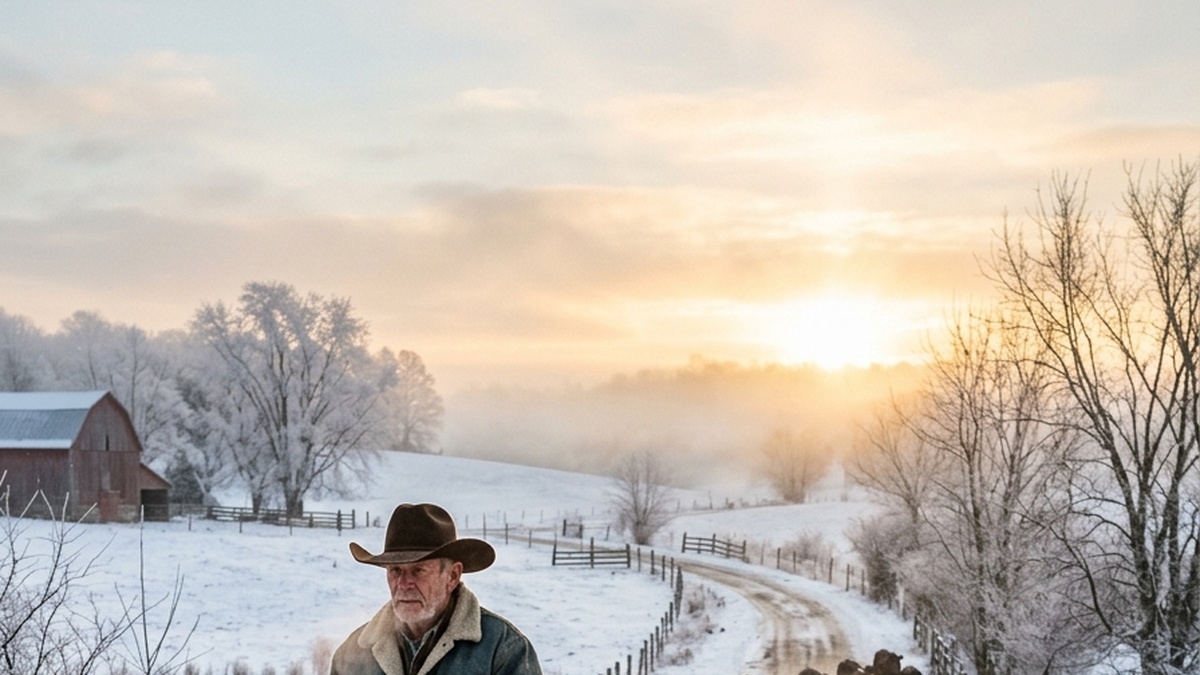
Jess Miller had forty cows, no trailer, no chute, and until Saturday noon to get every one of them off land that wasn't hers anymore.
Grady Pruitt said it nicely. Grady always said things nicely. He stood by his shiny truck in the barnyard on Hollow Creek Road with his hands in his good coat pockets and said, "Let's be reasonable. The bank moved my closing up to Monday. I need the place empty. I'm sorry, Jess, I truly am."
Then he drove away without a speck of mud on his tires.
Jess stood in the barn door and looked at her herd. Forty black and black baldy cows, most of them bred, spread across the hillside like somebody had spilled pepper. She had been an Army medic in Afghanistan. She had kept her head through things she did not talk about. She did not know how to move forty cows in four days.
Clay Hollister came out that afternoon because Bev Truitt at the sale barn told him to.
"That girl's got trouble," Bev had said over the phone. "And you've got eighty acres and a soft heart. Don't argue with me, Clay."
He did not argue. He drove over in his old Ford and listened.
The trouble came in three pieces. The loading chute on the rented farm had rotted out two winters ago, and the landlord never rebuilt it. Luke had broken his leg falling from the hayloft in October and was stuck in the house in a boot. And the county had just posted the Hollow Creek bridge at three tons after an inspection. A loaded stock trailer would never cross it. The long way around ran forty miles, and every stock trailer Jess could find was booked for the feeder sale on Saturday.
"I could sell them," Jess said. Her voice was steady, but her hands were not. "That's what they all tell me. Sell them Saturday and be done."
"Is that what you want?"
"No, sir. Those cows are the only thing Luke and I own that isn't on a payment."
Clay nodded. He looked down the valley toward his own place. Two miles down Creek Road, across the ford below the bridge, over Route 9, and up his lane.
"Then we'll walk them," he said.
Word got to the sale barn by Thursday.
Clay sat in his usual seat in the back row while Ray Dunbar ran a pen of heifers through the ring. Between lots, Ray leaned on his microphone and grinned up at the bleachers.
"Hear Clay Hollister's going to drive forty head down Creek Road like it's 1880," Ray said. "Somebody call John Wayne."
The bleachers laughed. Clay laughed too. He did not mind being laughed at. He had been thrown off broncs in front of eleven thousand people.
Tanner Briggs slid in beside him after the sale. Tanner was twenty-nine and bought cattle for a feedlot in Indiana. He was good with numbers and quick on a phone, and Clay had been teaching him the rest.
"Clay, I've got two four-wheelers and a heeler that'll bring anything," Tanner said. "We push them hard and fast down the road, they're at your place in forty minutes."
"You push them hard and fast, they'll be in four counties in forty minutes," Clay said. "Come Friday evening. Leave the dog home."
Friday evening, Clay sat on the board fence by the Millers' water tank for an hour and did not say a word.
Jess stood beside him. Tanner stood beside her and checked his phone.
The cows came down off the hill in their own time. Clay watched how they moved. Who came first, who hung back, who stood off by herself. Most people look at a herd and see a herd. Clay had spent eighteen years watching animals decide which way they were going to jump, and he could see the order in it like a seating chart.
An old brockle-faced cow came to the tank first. Number seventeen in her ear. The rest stood back and waited until she lifted her head.
"That one," Clay said.
"That's Granny," Jess said. "She's the oldest. She came with the first six we ever bought."
"She's your trail boss. We don't drive forty cows tomorrow. We lead one cow and let the other thirty-nine follow her."
Jess was carrying a white plastic bucket. She gave it a shake, and the cubes inside rattled. Granny's head came up. She walked straight over and pushed her nose into the bucket while the others drifted in behind her.
"Every evening for six years," Jess said. "That rattle means supper."
Clay smiled. "Then you're walking point. Bring the bucket."
They started at first light Saturday. It was cold enough to see the cows' breath.
Jess went first on foot, shaking the bucket every so often. Granny followed her through the gate, and the herd strung out behind Granny in a long, easy line. Clay rode Dutch, his old sorrel gelding, along the side of the herd, never behind it. When a cow drifted wide, he moved Dutch a step toward her shoulder and she drifted back. When she did, he eased off.
Tanner walked the back with a long stick and no dog, looking like he wanted to argue but didn't.
They passed the houses on Creek Road one by one. People came out on porches in their coats and hunting orange. Floyd Eckert stood at the end of his drive with his walker and gave Clay a little salute.
A mile in, Tanner caught up to Clay. "Huh," he said. "They're just walking."
"Cows don't want to run. They only run when you make them think they have to."
They reached the ford below the bridge at a quarter to nine. The creek was low and clear over the gravel. Granny stopped at the edge, sniffed the water, and stepped in after the bucket. The first cows followed her across.
That was when the hunter's pickup came around the bend above the bridge, too fast, with its horn going at a deer in the road.
Granny threw her head up. Behind her, twenty cows turned at once, and the whole back half of the herd broke up the bank toward Route 9.
And from the top of the bank, Clay could hear a loaded log truck coming down Route 9, gearing down hard for the hill.